Framework
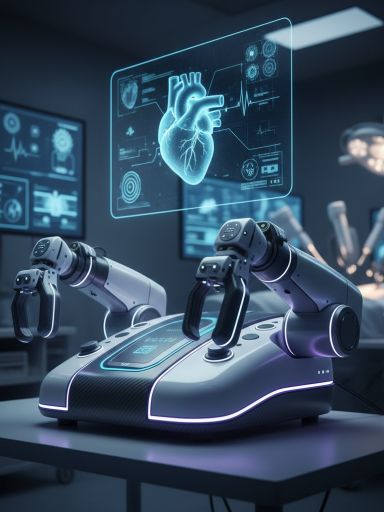
Physical Master Interface
We utilized a professional 6-Degree-of-Freedom (6-DOF) master console as our primary surgeon-side interface. By capturing high-resolution position and force telemetry, our software provides the transparency required for complex microsurgical tasks.
Tremor Suppression: By implementing CUDA-accelerated state estimation, we filter out physiological tremors and mechanical resonance in real-time, delivering a "zero-lag" tactile experience to the surgeon.
Sub-10ms Latency: Through parallel processing on the NVIDIA architecture, we maintain a control loop latency of less than 10ms, essential for surgical safety.
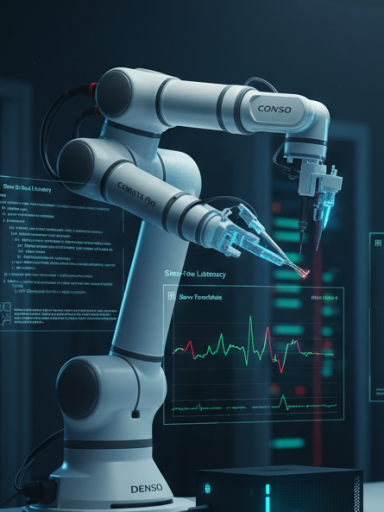
Sim-to-Real Pipeline
Virtual Robot: We have developed a comprehensive digital twin of the manipulator within NVIDIA Isaac Sim.
Physics-Based Validation: Using NVIDIA PhysX, we simulate complex tool-tissue interactions and latency variations. This allows us to stress-test our filtering algorithms in a virtual OR before any physical testing occurs on the hardware.
Synthetic Data Generation: We use the simulation to generate thousands of "edge-case" scenarios to train our safety guardrails, which would be impossible to replicate in a physical lab.
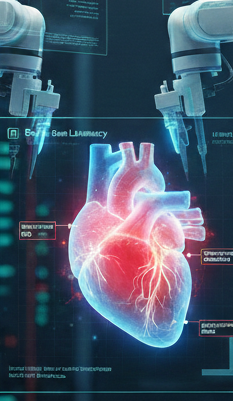
Computer Vision and Scene Intelligence
Intraoperative Segmentation: We leverage NVIDIA MONAI to perform real-time semantic segmentation of anatomical structures and surgical tools from the robot’s camera feed.
Active Safety Guardrails: By fusing Haption's haptic data with Denso's vision data, we create a Virtual Fixture a software-defined safety zone that prevents accidental tool-tissue collisions during critical maneuvers.
NVIDIA Holoscan Integration: Our vision-to-control pipeline is optimized for Clara Holoscan, enabling low-latency inference directly at the surgical edge.

Cyber Security & Clinical Reliability
We utilize NVIDIA BlueField Data Processing Units (DPUs) to isolate and accelerate security functions. By offloading encryption and firewall tasks from the main control CPU, we ensure that the follower robot’s command stream is protected from unauthorized access without adding latency to the haptic loop.
Our software stack is developed following IEC 62304 standards for medical device software. We utilize NVIDIA IGX’s dedicated "Safety Island" a specialized hardware zone that monitors the health of AI models in real-time.
Encrypted Haptic Telemetry: All bidirectional data between the surgeon’s console and the follower robot is encrypted in transit using high-speed hardware accelerators, meeting the rigorous data privacy requirements of the medical device standards.